Infrastructure, not a marketplace template.
One structural foundation for discovery, connection, and optional paid offerings — a single Exchange that grows from a shared link to a full marketplace, only when you're ready.
If you’re new to the concept, start with our overview of exchange infrastructure →
What exchange infrastructure means
Exonome is not a marketplace builder, directory template, or payments-first platform.
Exchange infrastructure provides a consistent foundation for discovery, coordination, and optional transactions for paid offerings — governed by the operator.
A single Exchange can support discovery, connection, and paid offerings at the same time, or emphasize only what fits its audience and context.
An Exchange, at a glance
An Exonome Exchange is a shared space where participation and offerings are intentionally curated and governed.
The operator controls who is invited, which offerings are approved, and when different capabilities are enabled.
Providers create offerings, and paid checkout is only introduced when marketplace capabilities are enabled.
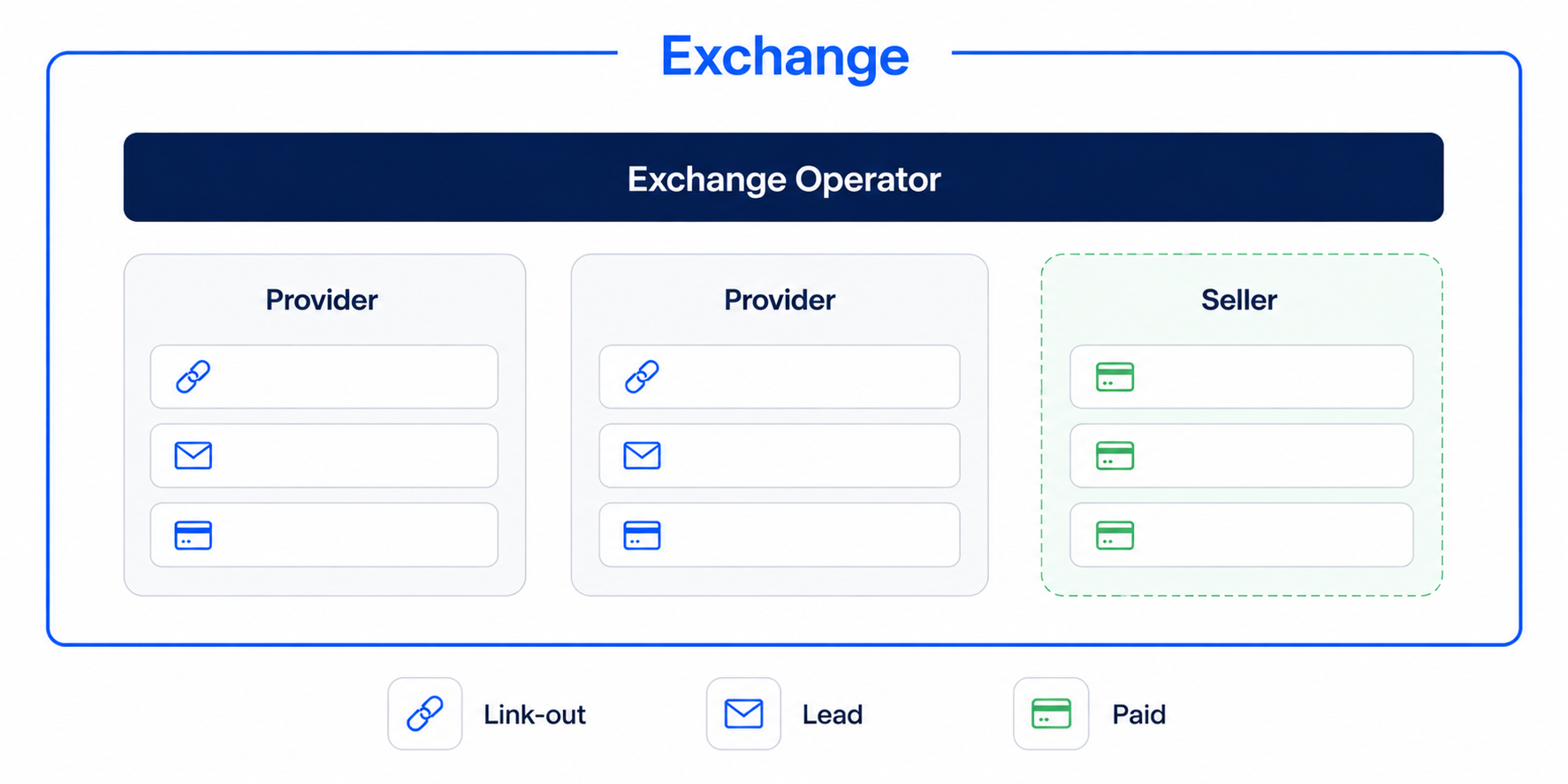
How exchanges take shape
An Exchange is configured by operator intent — not by a required sequence. Discovery, Connection, and Marketplace are independent configurations that can exist on their own or together.
Discovery Exchange
A single provider is surfaced for visibility and inbound interest through link-outs or lead requests — without coordination or transactions.
Connection Exchange
Operators invite and govern multiple providers. Inquiries, introductions, and participation are enabled without paid transactions.
Marketplace Exchange
Paid offerings and checkout are enabled. Providers may sell specific offerings while remaining discoverable and contactable.
Not sure where your exchange fits?
Most exchanges don’t start as clean categories. Discovery, coordination, and commerce often exist informally long before structure is introduced. The Exchange Clarity Tool helps you understand how exchange already works in your network — or what you’re intentionally designing toward — before choosing configuration or capabilities.
One Exchange, many ways to serve the same audience
Most marketplace platforms are built around a single transaction model — rentals, products, services, or bookings — and force every provider to fit that structure.
Exonome is different. A single Exchange can support multiple offering types at the same time, allowing different providers to serve the same audience in the ways that make sense for them.
Offering types
An operator invites a trusted network of providers and sellers to participate and be discovered. Each one merchandises their offerings using whichever offering types best fit how they actually deliver — so every offering shows up the way it's meant to be found and bought.
Link-out
Send customers straight to an external destination — your own site, a booking page, or a partner listing — when the action lives outside your Exchange.
Lead request
Capture inquiries and contact details so you can follow up and close on your own terms — no checkout required.
Product
Sell physical or stocked items with quantity selection and a familiar add-to-cart checkout.
Service
Sell a service customers book and pay for directly — checkout confirms the engagement, with no inventory to manage.
Rental
Rent out equipment or space — customers pick a start and end time, and availability is enforced for you.
Class
Fill recurring classes and sessions — customers choose a time from your schedule while seats and capacity are tracked.
Timed event
Sell access to a date-and-time event — customers reserve a specific slot before they pay.
Ticket
Sell admission to your event with quantity selection and issued access.
Subscription
Turn offerings into recurring revenue — customers subscribe for ongoing access with automatic billing.
Digital Download
Sell digital goods that unlock and deliver automatically the moment checkout completes.
Exchange capabilities by type
Each Exchange type supports a defined set of capabilities. Marketplace Exchanges are a superset — Discovery and Connection never block future expansion.
| Exchange Type | Discovery Exchange | Connection Exchange | Marketplace Exchange |
|---|---|---|---|
| Exchange structure | |||
| Number of Exchanges | 1 (shared instance) | Multiple † | Multiple † |
| Platform ownership | Exonome-owned | White-label platform owner | White-label platform owner |
| Custom domain |
Subdomain only * xxxx.exono.me |
Yes | Yes |
| Branding & white-label | |||
| Custom branding (logo, colors) | — | Yes | Yes |
| Remove "Powered by Exonome" attribution | — | Yes | Yes |
| Create exchanges under a platform (white-label) | — | Yes | Yes |
| Exchange Visibility & access | |||
| Public access | Yes (unlisted URL) | Yes (unlisted URL) | Yes (unlisted URL) |
| Access control | Public only | Public / private | Public / private |
| Customer portal | Yes | Yes | Yes |
| Discoverability, SEO & analytics | |||
| Search, tags, & category filtering | Yes | Yes | Yes |
| Cross-exchange offering distribution | — | Yes | Yes |
| Seller promotion | — | — | Yes |
| SEO & social (OG) meta | Yes | Yes | Yes |
| Traffic analytics (Google Analytics) | Yes | Yes | Yes |
| Provider & seller inclusion | |||
| Providers allowed | 1 | Multiple | Multiple |
| Invite & approve providers | — | Yes | Yes |
| Provider self-onboarding | Yes | Yes / mass imports | Yes / mass imports |
| Offerings & end-user actions | |||
| Link-out | Yes | Yes | Yes |
| Lead request | Yes | Yes | Yes |
| Product (quantity → cart) | — | — | Yes |
| Service | — | — | Yes |
| Rental (start / end) | — | — | Yes |
| Class (schedule selection) | — | — | Yes |
| Timed event | — | — | Yes |
| Tickets | — | — | Yes |
| Subscription | — | — | Yes |
| Digital download | — | — | Yes |
| $0 pricing (checkout) | — | — | Yes |
| Commerce & payments | |||
| Checkout & payment processing (Stripe) | — | — | Yes |
| Multi-seller cart (one checkout, split to sellers) | — | — | Yes |
| Seller payouts (Stripe Connect) | — | — | Yes |
| Discounts | — | — | Yes |
| Sales tax | — | — | Yes |
| Delivery & shipping options | — | — | Yes |
| Subscriptions & recurring billing | — | — | Yes |
| Order management & status tracking | — | — | Yes |
| Sales & order reporting | — | — | Yes |
| Refunds & cancellations | — | — | Yes |
| Referral & affiliate tracking | Yes | Yes | Yes |
| Workflows & controls | |||
| Commission/referral fee management | — | — | Yes |
| Provider messaging routing | — | Yes | Yes |
| Lead management | — | Yes | Yes |
| Offering approval workflow | — | Yes | Yes |
| Seller approvals for authorized payments | — | — | Yes |
| AI & automation | |||
| AI exchange setup (announcement, terms, privacy) | Yes | Yes | Yes |
| AI-generated banner & hero imagery | Yes | Yes | Yes |
| Exchange Clarity Tool (pre-configuration) | Yes | Yes | Yes |
* Custom subdomains on the shared Discovery instance may require an additional fee.
† Additional costs may apply for each additional Exchange.
Scale with flexibility and AI support
Exchanges can grow, enable commerce, or operate under different models, including white-labeled platforms. In any Exchange, AI supports both operators and participants with language, policies, and visual content — while keeping people in control.
Platform integrations
Exonome integrates with external systems based on how an Exchange is configured. Some integrations are available across all Exchange types, while others activate only when specific capabilities are enabled.
Stripe
Powers payments, payouts, subscriptions, and transaction flows for paid offerings.
Available only in Marketplace Exchanges.
Google Analytics
Provides web traffic insights and usage visibility through standard analytics reporting.
Supported in Connection and Marketplace Exchanges.
Twilio
Handles messaging, notifications, and SMS routing between operators, providers, and end users.
Used across all Exchange types. Default Exonome accounts may be replaced with dedicated accounts in white-label deployments.
Azure Storage
Stores images, documents, and digital assets used across Exchanges and offerings.
Used across all Exchange types. Default Exonome storage may be replaced with dedicated storage in white-label deployments.
How Exchanges support different user actions
Offering types control user inputs, interface behavior, and checkout requirements — without changing the Exchange, providers, or governance.
Discovery & contact actions
Link-outs and lead requests require minimal input and no checkout.
Scheduled & time-bound actions
Classes, events, and rentals require date or schedule selection.
Transactional actions
Products, services, and subscriptions require checkout and payment.
Marketplace as a superset
Discovery and connection remain available when paid offerings are enabled.
What Exonome never forces
No required commerce
Talk through your exchange
A short conversation to map structure, configuration, and intent.